How to Analyze Customer Interview Transcripts Without Losing the Evidence
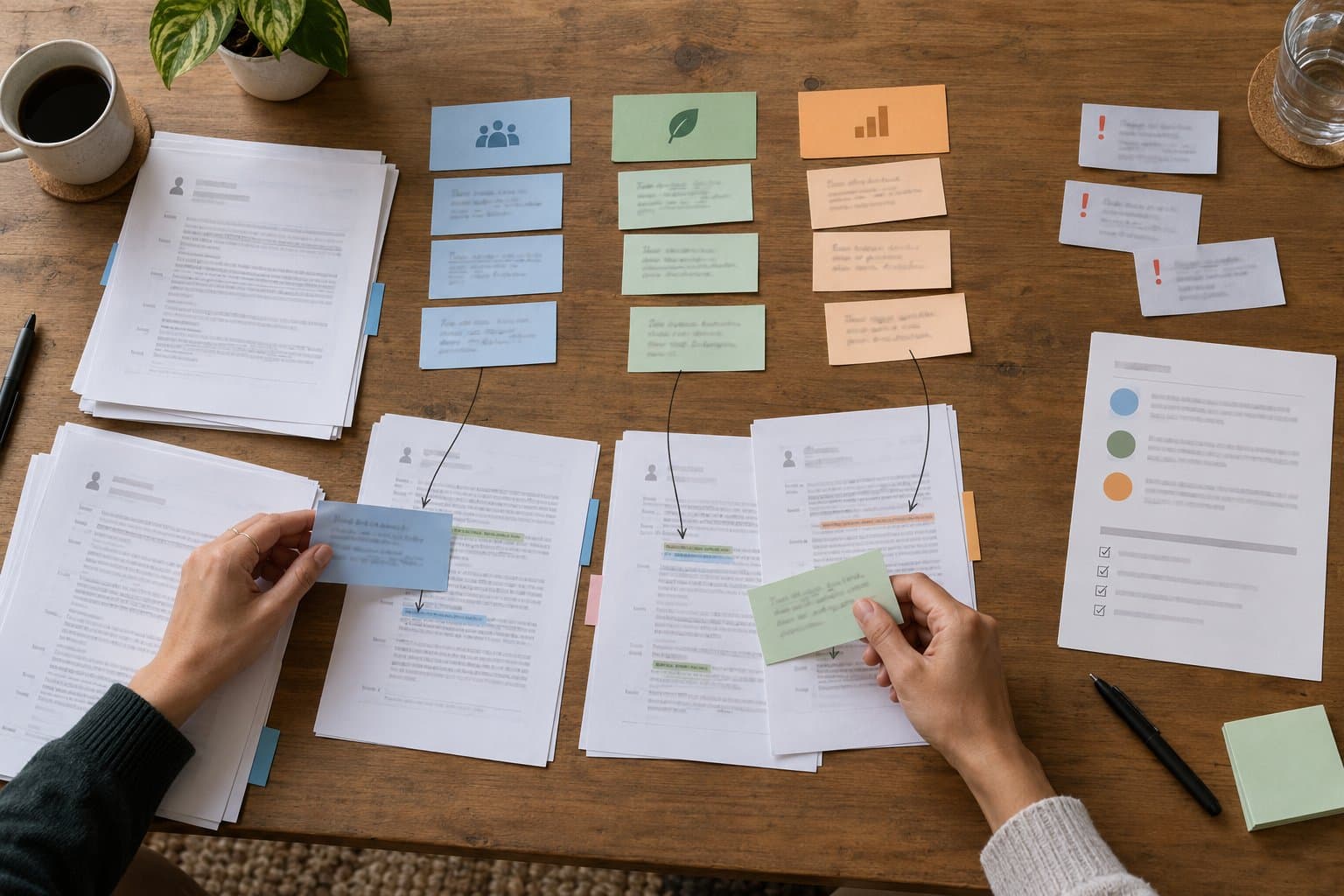
Customer interviews often end as a folder of long transcripts and a few memorable quotes. That is not yet analysis. The difficult part is finding patterns without flattening every participant into the same story, then showing which excerpts support each finding and which interviews disagree. A traceable workflow keeps raw evidence, interpretation, and product decisions separate so another person can review how you reached the conclusion.
Short answer
To analyze customer interview transcripts, write the decision the research must inform, give every session a neutral ID, read each transcript once, code observations and quotes, group related codes into candidate themes, and build an evidence table that includes supporting excerpts, contradicting evidence, and unanswered questions. A person who attended or understands the research should check every finding against the source before it influences a roadmap or product requirement.
Use AI to help extract and organize possible evidence, not to decide what customers meant. If you have only one interview, write a case summary rather than calling one person's experience a recurring theme.
Where this workflow is useful
Customer interview analysis turns recorded conversations into a reviewable account of problems, workarounds, language, differences, and open questions. The useful output is not a generic summary. It is a small set of findings connected to the exact sessions and excerpts that support or challenge them.
Use this workflow when several conversations need to inform one bounded decision. Do not use it to score people, infer facts a participant never stated, or treat a small qualitative sample as a market-wide percentage.
- Product discovery: compare how customers complete one task today and where the workflow breaks.
- Onboarding research: identify repeated points of confusion and the different conditions that caused them.
- Win-loss interviews: separate buying criteria, objections, and deal-specific circumstances.
- Churn research: distinguish the stated cancellation reason from earlier friction described elsewhere in the conversation.
- Usability follow-up: connect a participant's action to what they expected the interface to do.
- Service research: compare needs across customer types without erasing minority or edge-case experiences.
Start with the decision, not a list of themes
Before opening a transcript, write one sentence that names the decision and its boundary. For example: “Decide which part of first-project setup needs another round of design work.” That is narrower and more useful than “learn what customers think about onboarding.”
Then list two or three research questions the transcripts can answer. Keep proposed solutions out of this list. If a customer asks for a button, the evidence is the task they could not complete, the context, and the workaround—not proof that the requested button is the right design.
- Decision: what will change, stay unchanged, or receive more research?
- Scope: which product stage, customer group, and time period are included?
- Research questions: which behaviors, barriers, expectations, or outcomes are you comparing?
- Excluded claims: what cannot be concluded from this interview set?
Record and prepare interviews before analysis
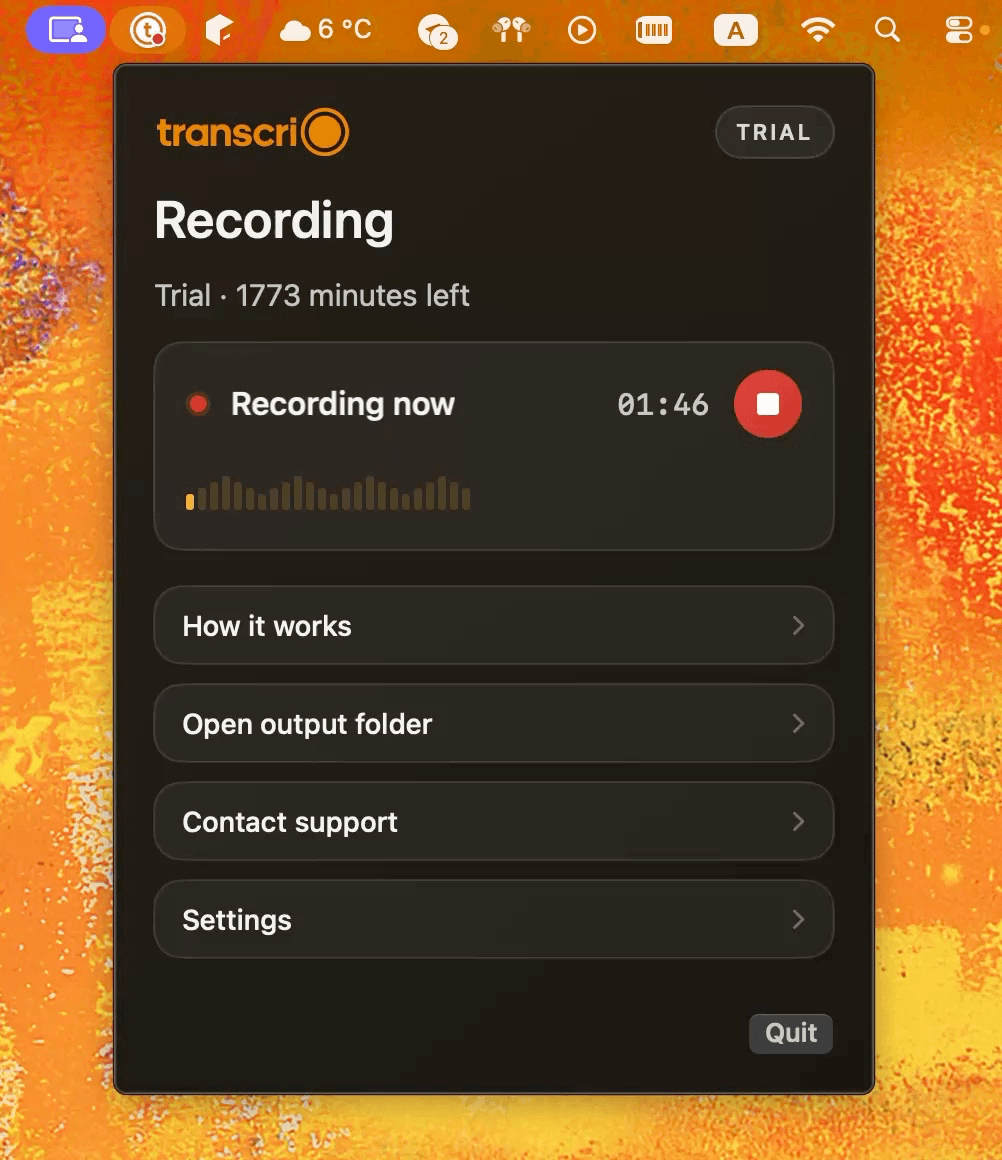
When an interview happens on a Mac and recording is permitted, Download Transcrio, make a short microphone and system-audio test, then keep the source recording beside the transcript and optional summary. Transcrio records locally on the Mac and does not join the call as a meeting bot. The source audio gives the reviewer somewhere to return when speaker labels, product names, or a sentence in the transcript look wrong.
The GOV.UK Service Manual recommends notes that stay close to observations and labels that identify the participant and session. It also distinguishes detailed transcripts from summaries that preserve only general meaning. Keep that distinction visible: a summary can help you orient yourself, but quote-level findings should return to the transcript or recording.
- Assign a neutral session ID such as P01; keep names and contact details out of the coding sheet.
- Add the interview date, research question set, customer segment only when relevant, and consent or usage boundary.
- Correct obvious speaker and product-name errors before copying excerpts into the evidence table.
- Keep a master transcript unchanged and work from a separate review copy.
See the Transcrio workflow
From recording on a Mac to a local transcript and summary.
Take a 1-minute interactive tour — no signup required.
Open in a new tabRead each transcript once before coding
Read the whole interview before breaking it into fragments. Note the participant's goal, current workflow, constraints, strong reactions, and anything that contradicts your expectations. Context changes meaning: “I never use export” may mean export is unnecessary, or it may mean the participant never found it.
Write a two- or three-sentence session memo after the first pass. A memo is not a final finding; it records the shape of this interview so you can later spot when a theme is being driven by one unusually vivid participant.
Code observations before proposing solutions
A code is a short label attached to one relevant excerpt. Keep it close to what happened: “cannot find import after upload,” “uses spreadsheet as workaround,” or “expects teammate approval.” Avoid solution-shaped codes such as “needs dashboard” unless the participant is explicitly describing a requested solution, and label that as a request rather than an observed need.
Use the same code definition across interviews, but allow a new code when the data does not fit. Merge duplicates only after you can explain why they describe the same behavior or constraint.
- Observation: what the participant did, said, expected, or avoided.
- Context: when and under which constraint it happened.
- Excerpt: the smallest quote that keeps the original meaning.
- Source: session ID and a timestamp or transcript location.
- Interpretation: what the observation may mean, written separately from the quote.
Build an evidence table across interviews
Move from codes to candidate themes only after several transcripts have been coded. Each row in the evidence table should name the theme, explain why it matters to the research question, list supporting sessions, preserve at least one source excerpt, and show any negative or contradicting case.
Frequency is context, not proof of importance. A problem raised by two of eight participants may still be critical if it blocks a required task; a phrase repeated by six people may be harmless. Report the observed sample plainly instead of turning it into a market percentage.
- Candidate theme and a one-sentence definition.
- Supporting session IDs and source excerpts.
- Contradicting evidence or a case where the theme did not apply.
- Conditions that may explain the difference.
- Confidence, gaps, and the next question to test.
Worked example: test an onboarding friction theme
Imagine five interviews about creating a first project. P01, P03, and P05 say they expected an import option immediately after creating the project; P03 and P05 describe copying data by hand. P02 found import through Settings and completed the task. P04 did not need import because the project started empty.
The first candidate theme is “import is hidden,” but the evidence does not support a universal statement. A better finding is: “Three of five participants who arrived with existing data expected import during first-project setup; two used a manual workaround. One found import later in Settings, and one started without existing data.”
The evidence table links that finding to four relevant excerpts, keeps P04 as a boundary case, and marks two gaps: whether the expectation changes by source tool, and whether people notice the current import entry when it is shown during onboarding. The usable output is a research finding plus a testable next step—not an automatic requirement to build a new importer.
- Starting input: five transcripts, one research question, and source timestamps.
- Observed pattern: three participants with existing data expected import earlier.
- Contradicting evidence: one participant found the current path; one had no import job.
- Decision boundary: the interviews reveal discoverability friction, not the correct interface solution.
- Usable output: an evidence-backed finding and a focused usability test for the next round.
Use AI for a first pass, then check every finding
An external AI tool can help extract candidate excerpts, normalize code labels, compare sessions, and draft an evidence table. Export only the material you are permitted to process, remove details the task does not need, and use a tool whose data handling fits your obligations. The guide to using transcripts with AI tools explains the file and prompt handoff in more detail.
Ask the model to cite the session ID and exact excerpt for every proposed code or finding, to list evidence that does not fit, and to mark unsupported claims as UNKNOWN. Then open the source transcript and check each cited passage. Reject a theme when its quotes are misread, stripped of context, or all come from one participant.
Transcrio does not run cross-interview thematic analysis, research repositories, affinity mapping, or product decisions. It records microphone and system audio on Mac and can produce a transcript and summary for each recording. Cross-interview coding, interpretation, and approval remain with the researcher and any external analysis tool they choose.
Choose the output your decision actually needs
Do not turn every analysis into a long slide deck. A design team may need a one-page finding sheet with evidence and open questions. A product manager may need a problem brief that separates observed behavior from solution ideas. A research repository may need coded excerpts and a short synthesis. Keep the master transcripts and source audio under the access and retention rules agreed for the study.
Archive the source material separately from the final decision document so later readers can tell which statements came from customers and which came from the team. A searchable local transcript archive can help with filenames, folders, and retrieval without pretending the archive itself has done the analysis.
Check the analysis before it changes the roadmap
Run a final source audit with someone who understands the research question but did not write every theme. Give them the evidence table, the selected excerpts, and access to the permitted source material. They should be able to trace each finding, understand why a contradicting case was kept, and see which claims remain uncertain.
- Every finding answers the original research question.
- Every finding links to at least one accurate source excerpt.
- Contradictions and minority cases are visible rather than deleted as noise.
- Participant requests are not silently rewritten as product requirements.
- Counts describe this interview set and are not presented as market prevalence.
- Personal details and quotes are handled within the agreed consent and retention boundary.
Next steps
FAQ
How many customer interviews do I need before identifying a theme?
There is no universal number. One interview can produce a useful case observation, but call something a recurring theme only when the pattern appears across relevant sessions and you have checked differences and contradictions.
Can AI analyze customer interview transcripts for me?
AI can propose codes, excerpts, and themes, but a person should verify every citation, restore context, review contradictions, and decide what the evidence means for the research question.
Does Transcrio analyze several customer interviews together?
No. Transcrio records audio on Mac and can create a transcript and summary for each recording. Cross-interview thematic analysis and research decisions happen in your chosen analysis workspace with human review.
Should I keep the source audio after transcription?
Keep it only as long as your consent, policy, and research plan allow. While retained, the audio helps resolve unclear wording, speaker-label errors, and excerpts whose meaning depends on tone or surrounding context.