How to Turn a Recruiting Interview Transcript Into Scorecard Notes

A recruiting interview transcript preserves what was said, but it is not a scorecard. Without a consistent review method, the clearest speaker or most memorable story can outweigh the job-related evidence the interview was meant to collect. Useful scorecard notes connect each criterion to a specific answer, show what the interview did not establish, and keep the final assessment separate from the transcript itself.
Short answer
To turn a recruiting interview transcript into scorecard notes, define the job-related criteria and rating anchors before the interview, review one question at a time, attach direct transcript evidence to the relevant criterion, mark missing or conflicting evidence plainly, and write the interviewer's assessment in a separate field. A trained person—not the transcript or an AI summary—should assign the rating and make the hiring recommendation.
If the interview did not ask a question that could reveal a required competency, write “Evidence not captured” and arrange a consistent follow-up. Do not infer the answer from confidence, speaking style, accent, camera presence, or information outside the agreed hiring process.
Where this workflow is useful
Scorecard notes are a structured record of what the candidate said in relation to criteria chosen before the interview. The useful result is not a polished personality summary. It is a compact set of evidence, gaps, and reviewer judgments that another authorized reviewer can trace back to the conversation.
Use the method when the interview has defined competencies and a human review process. If the team has not agreed on the role requirements or rating anchors, fix the interview kit first; a transcript cannot make an undefined standard consistent.
- Hiring-manager screen: capture evidence for the few must-have outcomes that determine whether a specialist interview is worthwhile.
- Technical or portfolio interview: connect each claim to the example, constraint, tradeoff, and result the candidate described.
- Leadership interview: separate the candidate's actions from team outcomes and follow up when ownership is unclear.
- Panel interview: give each reviewer the same source before they compare independent notes.
- High-volume recruiting: keep the note format consistent without turning a generated draft into an automatic hiring decision.
Define the scorecard before reviewing the transcript
A structured interview starts with job-related competencies, predetermined questions, and the same rating standards for every candidate. U.S. Office of Personnel Management structured interview guidance describes this approach as asking candidates the same questions and evaluating responses with the same scale and standards. Use your organization's approved interview kit; do not invent new criteria after reading a strong or weak answer.
For each competency, write what evidence a strong, mixed, and insufficient answer would contain. Keep the anchors behavioral and tied to the role. “Explains a tradeoff, names the decision, and describes the result” is reviewable; “seems strategic” is too vague to support consistent notes.
- Criterion: the job-related competency or outcome being assessed.
- Question: the prompt and permitted follow-ups used to collect evidence.
- Anchors: observable evidence expected at each rating level.
- Exclusions: traits or signals that should not affect the assessment.
- Missing-evidence rule: what the reviewer writes when the interview did not establish the criterion.
Record the interview and keep a verifiable source
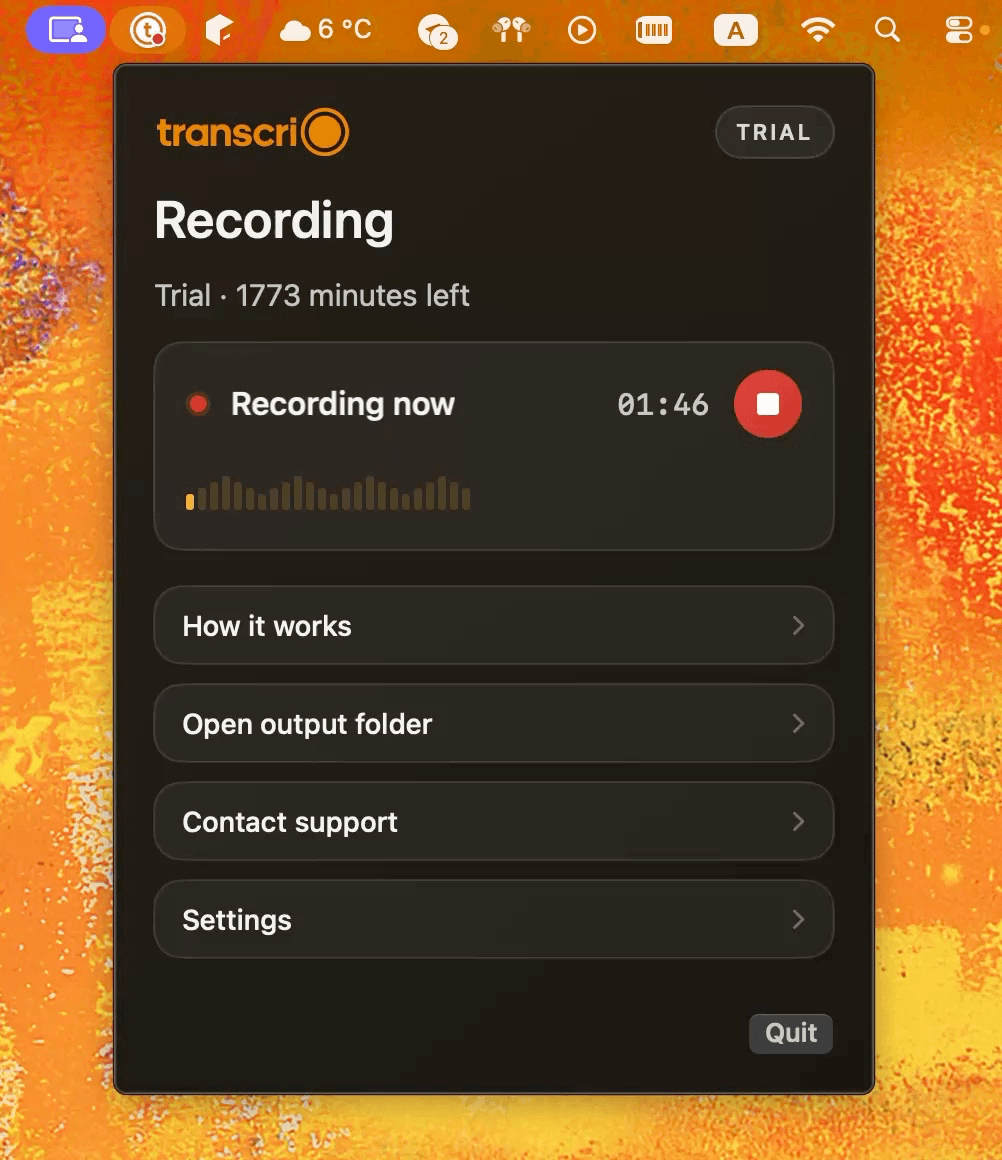
When recording is permitted, Download Transcrio on the Mac used for the interview, grant microphone and system-audio access, and make a short two-source test before the candidate joins. Transcrio records without adding a meeting bot, keeps the source recording in the selected Mac folder, and can create a transcript and optional summary after the call.
Keep the original recording available only as long as policy permits. It is the verification source when a technical term, speaker label, or sentence in the transcript looks wrong. Correct obvious transcription errors in a working copy, but preserve the untouched source and record any material correction.
- Confirm the notice and consent step before recording starts.
- Test that both the interviewer microphone and remote system audio are present.
- Name the session with a restricted internal ID instead of personal details where practical.
- Restrict the folder and delete files according to the approved hiring retention schedule.
See the Transcrio workflow
From recording on a Mac to a local transcript and summary.
Take a 1-minute interactive tour — no signup required.
Open in a new tabReview one question and one criterion at a time
Read the complete answer before extracting evidence. A single confident sentence can change meaning after a follow-up, and a result may belong to the candidate's team rather than to the candidate. Capture the smallest excerpt or faithful paraphrase that preserves the action, context, and outcome.
Add a timestamp or transcript location so another reviewer can verify the note without rereading the entire interview. When one answer supports more than one criterion, copy only the relevant evidence into each row and keep the same source reference.
- Question asked and any material follow-up.
- Candidate action stated in the answer.
- Context, constraint, tradeoff, and result when provided.
- Source timestamp or transcript location.
- Contradiction, ambiguity, or missing detail that affects the criterion.
Separate transcript evidence from interviewer judgment
Use separate fields for evidence and assessment. The evidence field should describe what the candidate said and where it appears. The assessment field should explain how that evidence matches the predefined anchor. This separation lets another reviewer disagree with the interpretation without changing the source record.
Do not fill silence with a guess. Use “Evidence not captured” when the question was skipped, the answer addressed a different competency, or the transcript is too unclear to verify. Use “Conflicting evidence” when two parts of the interview point in different directions, and include both references.
- Evidence: source-linked facts from the answer.
- Assessment: the reviewer's comparison with the approved anchor.
- Gap: what is still unknown or unverified.
- Follow-up: a consistent question or work sample that can close the gap.
- Rating and recommendation: completed by the authorized human reviewer.
Worked example: review a project leadership answer
Suppose the scorecard criterion is “surfaces delivery risk and aligns stakeholders.” The candidate describes a launch that was two weeks behind after an integration failed. They say they mapped the remaining work with engineering, proposed removing one nonessential feature, and told the customer about the revised scope before the next status call.
The transcript supports three notes: the candidate identified the delivery risk, brought engineering into the tradeoff, and communicated the change before the planned update. It does not establish who approved the scope cut, whether the launch met the new date, or how the customer responded. Those points remain gaps rather than assumed successes.
The finished scorecard row contains the criterion, three source-linked evidence bullets, the missing outcome details, and a reviewer assessment such as “Evidence supports early escalation and cross-functional alignment; delivery outcome remains unclear.” The reviewer can then apply the predefined rating anchor or ask the same approved follow-up used for any candidate with this gap.
- Starting input: one transcript answer, a job-related criterion, and its rating anchors.
- Confirmed evidence: risk identified, tradeoff discussed, and customer informed.
- Unresolved gaps: decision authority, final delivery result, and customer response.
- Human judgment: compare only the confirmed evidence with the predefined anchor.
- Usable output: an auditable scorecard row and a consistent follow-up question.
Use AI to draft evidence notes, not to score the candidate
An external AI tool can help locate passages, group evidence under existing criteria, and draft concise notes. Remove information the task does not need, use only approved tools, and ask for a source reference beside every proposed note. The transcript handoff guide shows how to require citations and mark unknowns instead of accepting unsupported summaries.
Reject any output that infers personality, emotion, honesty, culture fit, protected characteristics, or future performance from voice, accent, word choice, facial expression, or recording quality. Check each excerpt in the transcript and source audio, then let a trained interviewer write the assessment.
Transcrio does not score candidates or make hiring decisions. It records microphone and system audio on Mac and can create a transcript and summary for each permitted interview. The scorecard criteria, evidence review, rating, and hiring decision remain with the employer's authorized reviewers.
Calibrate the panel without erasing disagreement
Ask reviewers to complete their evidence notes and initial assessment before reading one another's conclusions. During the debrief, compare the source references behind different ratings. A disagreement may reveal a vague anchor, a missed follow-up, or genuinely mixed evidence; it should not be resolved by rewriting the transcript into a cleaner story.
Finish with a clear record of which criteria were supported, which remain uncertain, and which next step is allowed by the hiring process. Share only the reviewed scorecard output with the people who need it, not a broad transcript export by default.
- Every evidence note has a verifiable source location.
- Every assessment refers to a criterion and its predefined anchor.
- Missing and conflicting evidence remains visible.
- Reviewers distinguish the candidate's actions from team outcomes.
- The final rating and recommendation are human-authored and access-controlled.
Next steps
FAQ
Can AI turn an interview transcript into a completed scorecard?
AI can draft source-linked evidence notes under criteria you already defined. A trained reviewer should verify every excerpt, record missing or conflicting evidence, apply the rating anchors, and make the hiring recommendation.
What should recruiting interview scorecard notes include?
Include the criterion, the question, a faithful evidence note, a timestamp or transcript location, missing or conflicting details, the reviewer's assessment, and the human-assigned rating when your process requires one.
What if the interview transcript does not contain evidence for a criterion?
Write “Evidence not captured.” Do not infer a rating from speaking style or unrelated answers. Use the same approved follow-up or work sample you would use for another candidate with the same gap.
Does Transcrio evaluate recruiting candidates?
No. Transcrio records permitted interviews on Mac and can create a transcript and summary. It does not score candidates, apply hiring criteria, or make employment decisions.